Views: 0 Author: Site Editor Publish Time: 2026-08-18 Origin: Site


Receiving a bulk container of defective commercial outdoor furniture carries severe financial and operational risks. Replacement delays postpone resort openings and cause lasting brand damage. Standard factory visual inspections remain insufficient for high-volume orders. Surface-level aesthetics often mask structural weaknesses, poor coating adhesion, or subpar hardware. These hidden flaws inevitably fail under heavy commercial use. You need a rigorous, multi-point pre-shipment quality control framework. This system verifies structural integrity, weather resistance, and ergonomic durability before you authorize any shipment. Relying on factory promises leads to collapsed frames on pool decks and ruined guest experiences. Implementing strict inspection protocols ensures every unit meets exact specifications. You must verify metal thickness, weld quality, and coating durability through standardized testing. This proactive approach eliminates surprises upon delivery and protects your investment.
Alloy and Structural Verification: Commercial-grade loungers require specific aluminum wall thicknesses (typically 1.5mm–2.0mm) and flawless, full-circumference welding to withstand high-traffic environments.
Coating and Corrosion Defense: Powder coating must undergo cross-cut adhesion testing, thickness verification, and salt-spray simulation to ensure long-term resistance to UV degradation, pool chlorine, and saltwater environments.
Hardware and Mechanism Reliability: Adjustability tracks, hinges, and fasteners must be stress-tested for thousands of cycles using marine-grade (304 or 316) stainless steel components.
Design-Specific Functional Checks: Stackability verification, protective bumper presence, and multi-material integration (such as teak or HDPE accents) must be tested to prevent transport and operational damage.
Third-Party Validation: Engaging independent inspection agencies for Pre-Shipment Inspections (PSI) mitigates the risk of factory bias and ensures adherence to agreed-upon specifications.
Failing furniture in hotels and resorts creates massive liabilities. Collapsed frames lead to guest injuries and potential lawsuits. Poor quality triggers negative guest reviews that harm property reputations. Returning defective goods internationally creates a logistical nightmare. You must establish strict baseline requirements for commercial-grade furniture. An aluminium sun lounger must support weight capacities exceeding 150kg. It should offer a five-year lifespan in coastal climates with zero maintenance requirements. When a guest drops heavily onto a frame, it must hold firm. When exposed to daily salt spray, it must resist oxidation.
Bulk buyers specify powder-coated aluminum over alternatives like teak or HDPE plastic. Aluminum offers distinct weight and maintenance advantages. However, factories sometimes substitute lower-grade alloys or thin-walled frames to cut costs. They might use 1.0mm tubing instead of the specified 1.5mm. This shaves material costs but destroys structural integrity. Relying solely on manufacturer-provided QC reports presents an inherent conflict of interest. Factory inspectors work for the manufacturer, not the buyer. Independent verification remains necessary to ensure you get exactly what you ordered.
Consider the operational impact of a failed shipment. If a resort orders 500 loungers for a grand opening and 30% arrive with scratched powder coating or wobbly legs, the opening is compromised. You cannot easily source 150 commercial-grade replacements locally. The lead time for a new container spans months. Pre-shipment inspections catch these issues while the goods still sit on the factory floor. You can force the manufacturer to rework or replace defective units before they cross the ocean.
Inspection Category | Factory Self-Reporting Risk | Independent QC Advantage |
|---|---|---|
Material Thickness | Often measures the thickest part or includes coating thickness to pass specs. | Uses calibrated digital calipers on raw aluminum before coating. |
Weld Quality | Visual check only; ignores internal porosity or incomplete penetration. | Physical stress tests and detailed visual inspection of all joint circumferences. |
Coating Adhesion | Rarely performs destructive testing on finished goods. | Executes ASTM D3359 cross-hatch tests on random production samples. |
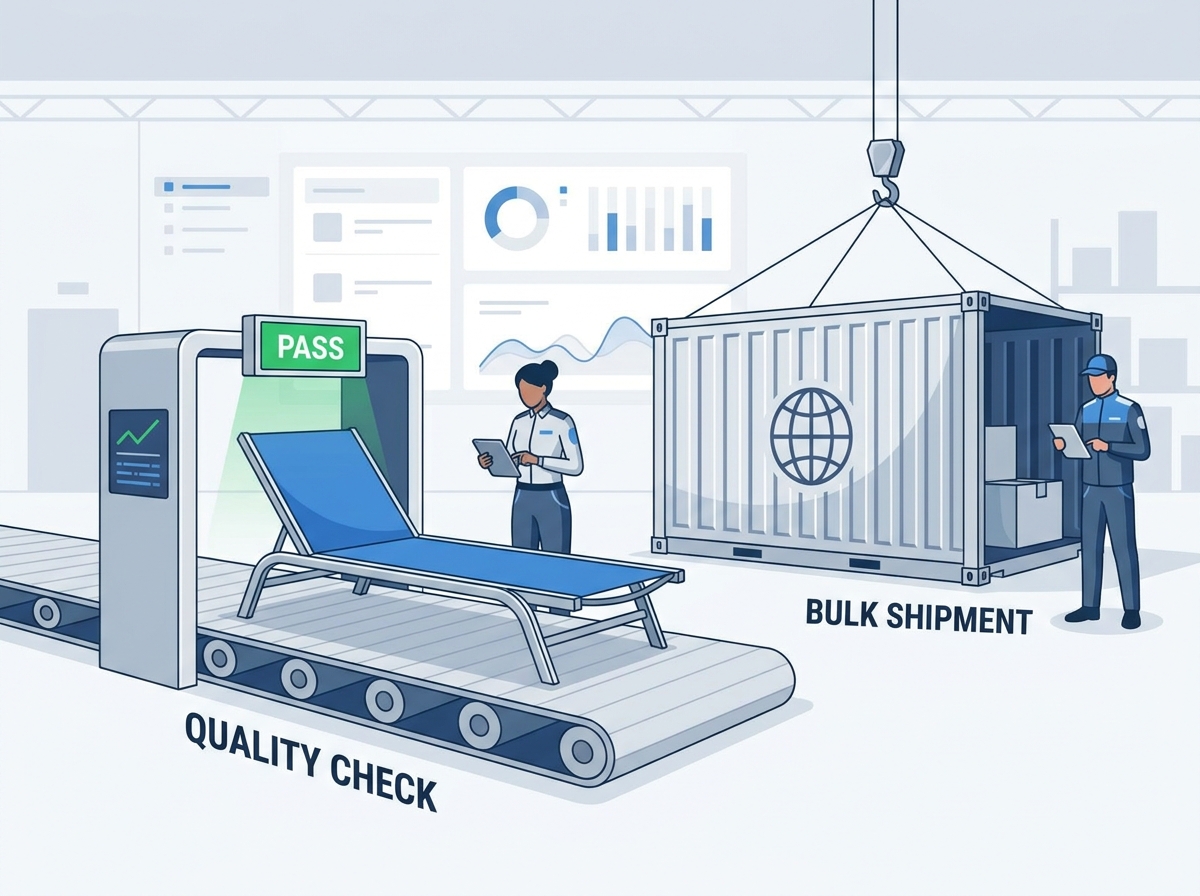
Inspectors must verify tube wall thickness against approved technical drawings using digital calipers. Commercial applications typically demand 6061 or 6063 aluminum alloys. The 6061 alloy offers higher yield strength, making it ideal for load-bearing main frames. The 6063 alloy provides better surface finishing qualities, often used for visible armrests or decorative extrusions. Inspectors check the raw tubes before the powder coating process. Coating adds thickness, which factories sometimes use to mask undersized aluminum.
Visual and mechanical weld inspections determine joint reliability. Acceptable welds must be smooth and continuous without porosity or slag inclusions. Full-welded joints are mandatory. Spot-welded joints remain unacceptable for commercial use because they snap under repeated stress. TIG (Tungsten Inert Gas) welding is preferred for aluminum furniture. It produces clean, precise welds. Inspectors look for consistent "stack of dimes" bead patterns. Any undercut or burn-through indicates poor welding technique and a high probability of failure.
Load-bearing and stress testing protocols expose weak frames before shipping. Inspectors execute specific procedures to validate structural integrity:
Static Load Test: Apply 150kg to 200kg static weights to the center of the seat and the backrest. Leave the weights in place for 24 hours. Measure any permanent deflection or bending after weight removal.
Dynamic Impact Test: Drop a 100kg sandbag from a height of 15cm onto the seat assembly multiple times. This simulates heavy users dropping onto the frame abruptly.
Armrest Downward Force Test: Apply 90kg of downward force to the armrests to simulate a user pushing off to stand up. Check for weld cracking at the armrest joints.
Frame alignment and leveling checks are equally vital. Inspectors place the furniture on flat-surface granite slabs. All four legs must touch the ground simultaneously. A tolerance of 1mm to 2mm might be acceptable depending on the design, but anything more causes wobbling. Wobbling furniture annoys guests and accelerates joint wear. If the frame rocks on the granite slab, the factory must adjust it using leveling jigs before packaging.
Coating thickness gauges verify that powder coating hits the target range of 60-80 microns. Too thin, and the metal corrodes. Too thick, and the coating becomes brittle and chips easily. Inspectors use the cross-hatch cutter test (ASTM D3359) to check adhesion. They cut a grid into the coating, apply specialized tape, and pull it off rapidly. If paint flakes come off with the tape, the adhesion fails. This ensures the paint will not peel under stress.
Pre-treatment verification dictates long-term corrosion resistance. You must verify the factory's acid-washing and chromating or phosphating processes prior to powder coating. Aluminum naturally forms an oxide layer. If the factory does not strip this layer and apply a proper chemical conversion coating, the powder coat will not stick. Inspectors review the factory's pre-treatment tanks. They check chemical concentration logs and water rinse purity. Poor pre-treatment is the leading cause of coating failure in coastal environments.
Salt spray and chlorine resistance simulations expose coating vulnerabilities. ASTM B117 salt spray testing verifies that stylish aluminum outdoor sun loungers can withstand high-salinity coastal winds. It also confirms resistance to corrosive chlorine environments without pitting or bubbling. You should demand lab reports showing at least 1,000 hours of salt spray resistance without significant blistering or creepage from a scribed line.
Inspectors must check hidden areas carefully. The underside of joints, drainage holes, and internal tube channels often receive inadequate coating. Powder coating relies on electrostatic charge. Faraday cage effects can prevent powder from reaching tight inside corners. This oversight leads to premature oxidation. Water enters through drainage holes. If the inside of the tube lacks protection, it corrodes from the inside out. Inspectors use inspection mirrors and flashlights to examine these hard-to-reach areas.
Coating Defect | Root Cause | Inspection Method |
|---|---|---|
Orange Peel | Improper powder flow, incorrect curing temperature. | Visual inspection under bright, angled lighting. |
Pinholing | Moisture in the substrate, outgassing during cure. | Visual inspection, coating thickness gauge anomalies. |
Poor Adhesion | Inadequate chemical pre-treatment or oil residue. | ASTM D3359 Cross-hatch tape test. |
Thin Coverage | Faraday cage effect in corners, poor gun technique. | Digital coating thickness gauge on internal angles. |
Multi-position backrests require rigorous mechanism stress-testing. Inspectors cycle-test reclining mechanisms for over 5,000 adjustments. This ensures locking tracks do not wear down, slip, or bend under load. The ratcheting system must engage positively at every angle. If the teeth on the adjustment track are too shallow, the backrest will collapse when a user leans back. Inspectors manually test the mechanism on random samples, feeling for smooth operation and secure locking.
Fastener quality directly impacts longevity. All screws, bolts, and washers must be non-magnetic, marine-grade stainless steel. Grade 304 is standard, but Grade 316 is necessary for beachfront properties. Using cheap galvanized steel fasteners causes galvanic corrosion when the hardware contacts the aluminum frame. The dissimilar metals react in the presence of moisture, rapidly destroying the aluminum around the bolt hole. Inspectors use magnets to quickly identify substandard steel fasteners on the assembly line.
Mobility wheels and anti-slip foot glides require material evaluation. High-density TPR (Thermoplastic Rubber) or nylon components resist wear better than cheap plastics. Inspectors check attachment methods to ensure these parts will not detach during dragging. Foot caps should be inserted deeply into the aluminum tubing and secured with a mechanical fastener or high-strength industrial adhesive. Press-fit caps often fall out after a few weeks of use on rough concrete pool decks.
Commercial orders of stackable loungers require protective bumper audits. Protective rubber or nylon bumpers must be securely attached. They prevent metal-on-metal scratching and protect the powder-coated finish during stacking and storage. Inspectors stack and unstack the units multiple times. They check if the bumpers align correctly and if any part of the metal frames touch. Missing or misaligned bumpers lead to massive cosmetic damage during transit and daily resort operations.
Sling-style loungers rely on mesh tension and sag resistance. Inspectors test PVC-coated polyester fabrics like Textilene or Batyline under heavy loads. The fabric must return to its original tautness after prolonged exposure. A saggy sling looks terrible and provides poor ergonomic support. Inspectors apply a 100kg weight to the center of the sling for several hours. Upon removal, they measure the fabric's recovery. High-quality mesh recovers instantly. Cheap mesh stretches permanently.
Stitching, seam strength, and weatherproofing require close examination. Inspectors verify double-stitched seams using UV-resistant thread, such as PTFE (Teflon) thread. Standard polyester thread rots quickly under intense sun exposure. For cushioned models, factories must use high-density, quick-dry reticulated foam. This open-cell foam allows water to pass straight through, preventing mold and mildew. Inspectors pour water over the cushions to verify drainage speed and check the water-repellent fabric treatments.
Color fastness and UV exposure testing maintain aesthetic standards. Inspectors check color consistency across different fabric batches. A slight shade variation between rolls of fabric looks glaringly obvious when fifty units line up next to a pool. They verify manufacturer certifications for UV resistance, such as Xenon arc exposure testing results. Fading fabrics ruin the premium look of commercial outdoor spaces. You need documentation proving the fabric can withstand at least 1,500 hours of UV exposure with minimal color degradation.
Transit protection starts with ISTA drop-test standards for carton packaging. Inspectors verify the use of sufficient internal dunnage. Bubble wrap, foam corners, and cardboard dividers prevent metal-on-metal scratching during transit. The packaging must withstand rough handling by forklift operators and port workers. Inspectors perform a standard carton drop test from various heights and angles. They then open the box to check for any damage to the frame, coating, or fabric.
Moisture control during sea freight is critical. Inspectors check for silica gel desiccants within the packaging and the container itself. This prevents container rain and mold growth on fabrics during long voyages. Temperature fluctuations during ocean transit cause condensation inside the shipping container. Without adequate desiccants, this moisture drips onto the cartons, weakening the cardboard and breeding mold on slings and cushions. Inspectors verify the placement of high-capacity desiccant poles hanging from the container walls.
Verifying documentation and compliance standards prevents customs delays. All shipping marks, barcodes, and regulatory labels must match the purchase order exactly. Fire safety tags for cushions must comply with destination country regulations, such as California TB117-2013 or UK Fire Regulations. Accurate labeling ensures smooth logistics and legal compliance upon arrival. Inspectors check the container loading process to ensure workers do not step on cartons or cram units too tightly, which causes crushing damage.
Commissioning bespoke, architecturally unique designs carries higher QC risks and longer lead times. Custom tooling requires extensive prototyping and testing. Purchasing established, factory-standard molds offers more predictable quality because the factory has already ironed out the manufacturing defects. Trend-forward designs incorporating mixed materials present unique QC challenges. Wood-look aluminum, teak armrests, or HDPE accents have varying thermal expansion rates. Inspectors must verify joint stability to ensure these materials do not warp, crack, or separate under extreme temperature changes.
Establishing clear pass/fail thresholds requires an Acceptable Quality Limit (AQL) framework. Buyers typically set AQL 1.5 for major defects and 4.0 for minor defects. Major defects include structural cracks, missing hardware, or deep scratches exposing bare metal. Minor defects include slight color variations or small scuffs on non-visible surfaces. This provides a measurable, objective standard for bulk orders. If the number of defects in the random sample exceeds the AQL limit, the entire shipment is rejected.
Hiring third-party inspection agencies offers an excellent return on investment. The fee for an independent inspector is negligible compared to the massive financial loss of receiving a container full of unsellable inventory. A standard man-day for an inspector in major manufacturing hubs costs a fraction of the shipping fees alone. They provide detailed photographic reports, physical testing results, and an unbiased assessment of the factory's output. This data empowers you to negotiate rework or discounts before transferring the final balance payment.
Pre-shipment inspection is essential for verifying that commercial aluminium sun loungers meet the structural, functional, and visual standards agreed upon before production. A complete inspection should cover alloy and wall thickness, weld continuity, frame alignment, load capacity, powder-coat adhesion, corrosion resistance, hardware grade, reclining mechanisms, sling tension, and stacking protection.
Packaging and container loading also require verification because inadequate wrapping, moisture control, or carton support can damage otherwise acceptable furniture during sea freight. Clear AQL limits should distinguish critical, major, and minor defects and provide an objective basis for shipment approval or rejection.
Independent inspection reduces reliance on factory self-reporting and allows defects to be corrected before the final balance is paid. Effective quality control protects guest safety, project schedules, brand standards, and the long-term value of the furniture investment.
A: Commercial applications require a minimum aluminum wall thickness of 1.5mm to 2.0mm. This thickness provides the necessary structural integrity to withstand heavy daily use and support weight capacities exceeding 150kg without bending.
A: Inspectors use a coating thickness gauge to ensure a 60-80 micron depth. They also perform the cross-hatch cutter test (ASTM D3359) to verify strong adhesion and ensure the paint will not flake under stress.
A: Request ASTM B117 salt spray testing documentation from the manufacturer. This standardized test simulates highly corrosive environments to ensure the frame and coating will not pit, bubble, or oxidize prematurely.
A: The industry standard for commercial outdoor furniture is typically AQL 1.5 for major defects (like structural flaws) and AQL 4.0 for minor defects (like small cosmetic scratches). This sets clear rejection thresholds.
A: Joint failure usually occurs due to inadequate spot welding instead of full-circumference continuous welding. It can also happen if the factory uses a lower-grade aluminum alloy that lacks the necessary yield strength.
A: PVC-coated polyester fabrics, such as Textilene or Batyline, are ideal. They offer excellent sag resistance, UV protection, and quick-drying properties required for high-traffic commercial pool environments.
A: Ensure the factory places sufficient silica gel desiccants inside individual cartons and hangs high-capacity desiccant poles inside the shipping container to absorb excess moisture and prevent container rain.


